“You’ve Been Accepted”
"We have wrapped up our jurying process for our 2026 residency and are thrilled to let you know that you've been accepted as one of our two artists-in-residence."
Back in December 2025, I received one of those emails that, as an artist who has spent years sending in submission after submission, is always a thrill. I had been accepted.
The funny thing is, I hadn't been tracking this application, which I had submitted months earlier, and was completely caught off guard—not only by the honor itself, but by the realization that in five months I would be leaving for two weeks on Minnesota's North Shore to be an artist-in-residence. Whatever that was.
In 2012, the Grand Marais Art Colony launched its Artist-in-Residence program, providing artists with independent workspace in an environment of creative freedom to support the development of new work through aesthetic inquiry, creative risk-taking, experimentation, and artistic growth. So said the GMAC website.
A residency also meant Time and Space. That much seemed obvious.
I'm not much of a planner, but with five months to consider what to do—and how to be—with two weeks in Grand Marais ahead of me, I got busy.
The first thing I did was reach out to other artists and ask about their experiences with residencies.
"Don't bring too much stuff."
"Make sure to bring everything you'll need—it will be impossible to get supplies."
"It was transformational."
"Manage your expectations."
Helpful and confusing advice. Everyone has their own experience; that much seemed obvious, too. Still, I wanted to prepare. I wanted to get a handle on what my experience could, would, or should be.
So naturally, I bought a book.
Contemporary Artist Residencies: Reclaiming Time and Space is a collection of writings from artists, theorists, and residency facilitators examining the role of artist residencies within today's international art ecosystem. It was less a guide to what to bring or how to be and more a complex analysis of the historical and ideological implications of the residency model.
I do recommend the book. And yet, I still felt unmoored and disconnected from the opportunity that was quickly approaching. I kept coming back to that phrase: "you've been accepted."
I realized it both hooked my ego and made me feel terrible about myself. Me? Accepted to an artist residency? How is that possible? I'm not a real artist. I have no pedigree, no art degree. I just rent a studio and paint. Not to mention, I didn't start painting until I was almost fifty years old. All sorts of self-pitying, self-deprecating crap. I tried to shove it down and continued my intellectual pursuit of what an artist-in-residence could be.
Then May 11, 2026 arrived, and I was in Grand Marais. Whatever it was, I was now the artist at the residency.
I did the things I know how to do. I unpacked and settled into the cozy room in the charming house that would be my home for the next two weeks. I set up my studio space, arranging my supplies and equipment.
Space and Time.
It had started.
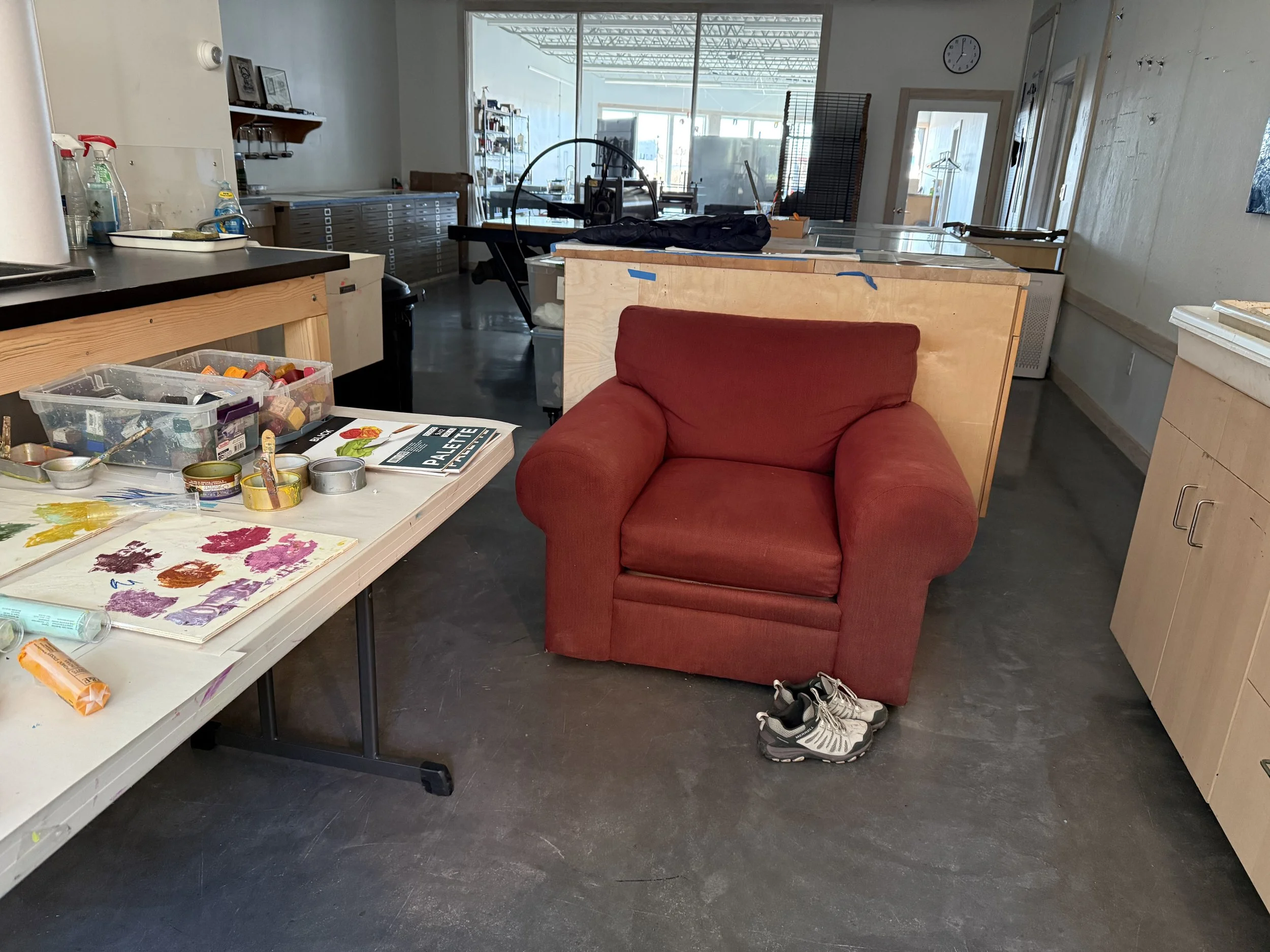
As I was leaving the studio that first night to lock up, I noticed a big, overstuffed lounge chair sitting on the loading dock. Was it being thrown away? The next morning, I asked the director what the deal was with the chair and whether I could have it in my studio for the duration of my stay.
Yep. No problem. By mid-morning, the chair had been moved from the dock into my space.
Sometimes a phrase, an image, or an unexpected thing crosses your path and answers questions you didn't fully realize you were asking.
That big, overstuffed lounge chair being carried into my studio so effortlessly by the GMAC team answered something for me. The imposter syndrome I had been trying so hard to push away finally came out into the open. So, I sat with that feeling for a morning, coffee in hand, in my big, fat, ugly chair. "You've been accepted" quietly became "You belong."
Then I started painting.